75 ATS resume keywords for 2026 and how to use them without keyword stuffing.
Getting hired in 2026 often depends on what happens before a recruiter ever sees a resume.
Most companies now rely on applicant tracking systems (ATS) to sort and filter applications at scale. These systems use a combination of AI, keyword matching, and ranking models to interpret resumes and compare them against job descriptions.
Rather than scanning for exact terms alone, they look at how experience is described, how skills relate to each other, and how closely a candidate's background aligns with the role.
Research from platforms like LinkedIn and other hiring studies suggests that these systems increasingly shape early-stage hiring decisions, especially in roles where companies receive large volumes of applications.
For a closer look at how this process works in practice, see our guide on what an Applicant Tracking System is.
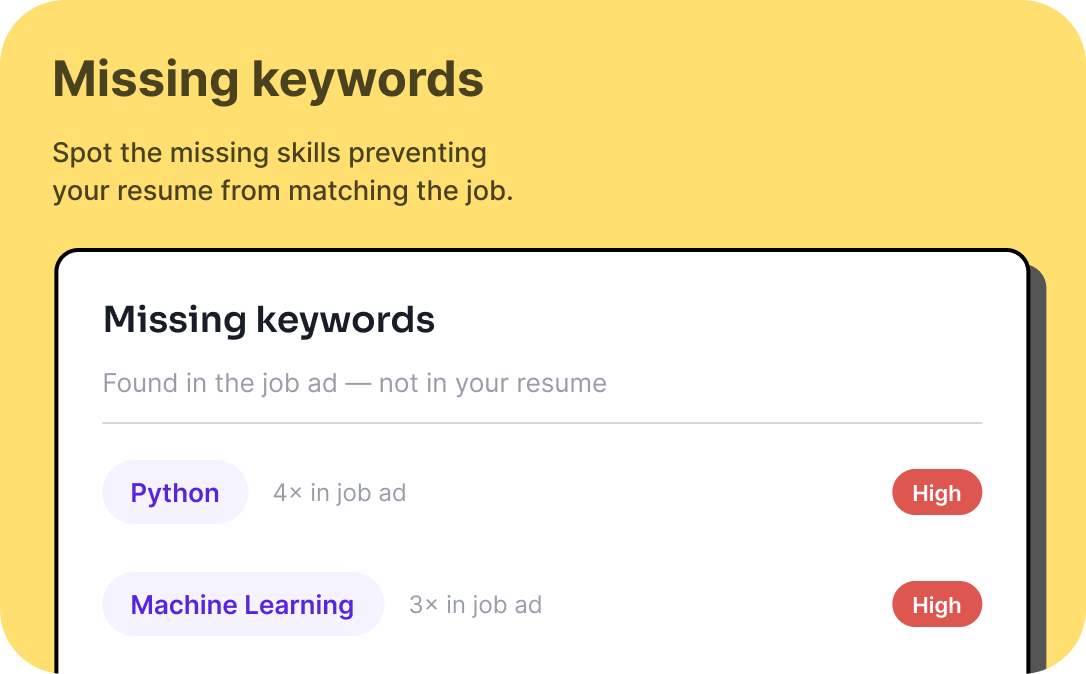
For you as a candidate, this means small differences in wording can have a real impact on visibility. If you want to see how your resume compares against a job description and whether it passes ATS filters, we recommend using our free tool called ResumeLime. It highlights missing keywords and alignment gaps so you can quickly understand what may be holding your application back.
How ats systems work today (2026 update)
Years ago, applicant tracking systems were often described as simple keyword filters. If a job description mentioned "Excel" five times, people assumed adding "Excel" five times to their resume would improve their chances. That advice is unfortunatily outdated.
Modern ATS software has become much more sophisticated. Instead of simply looking for exact keyword matches, many systems analyze your resume in context. They compare your experience, skills, and job titles with the requirements in a job description to estimate how closely you match the role.
For example, imagine a company is hiring a project manager.
The job description might mention skills such as Agile methodology, stakeholder management, sprint planning, and cross-functional collaboration.
If your resume only says:
Managed multiple projects.
...you technically have relevant experience, but you're giving the ATS very little information to work with.
Compare that to this:
Led cross-functional Agile teams, coordinated sprint planning, and managed stakeholder communication across multiple product launches.
Both statements describe project management experience, but the second provides far more context. It also includes the language recruiters and ATS software expect to see for that type of role.
This is why simply adding keywords to a skills section is no longer enough. Modern ATS systems look at where a keyword appears and how it's used. A skill supported by real work experience carries far more weight than the same skill listed without evidence.
Most ATS platforms also build a structured profile from your resume by identifying information such as:
- Previous job titles
- Technical skills and software
- Certifications
- Education
- Years of experience
- Quantifiable achievements
Recruiters often search this structured data rather than reading every resume from top to bottom. The more accurately your resume reflects the language used in the job description, the more likely it is to appear in those searches.
What are ats resume keywords?
ATS resume keywords are simply the words and phrases that describe what you know and what you've done.
Some keywords refer to technical skills, like Python, SQL, or financial modeling. Others describe software you've used, such as Salesforce, Tableau, or Microsoft Excel. You'll also find keywords that relate to soft skills or business concepts, including stakeholder management, strategic planning, and customer success.
The important thing to understand is that there isn't a universal list of ATS keywords.
A software engineer and a marketing manager might both be strong candidates, but the keywords that matter for each role are completely different.
That's why copying a generic list of keywords into your resume rarely works. The most valuable keywords are the ones taken directly from the job description you're applying for.
Think of ATS keywords as a common language between employers and candidates. Your resume should describe your experience using the same terminology the employer uses to describe the job.
When both sides speak the same language, it's much easier for both the ATS and the recruiter to recognize that you're a strong match.
Top 75 ATS resume keywords for 2026
Technical and analytical skills
- Data analysis
- Machine learning
- Artificial intelligence
- SQL
- Python
- Data visualization
- Statistical modeling
- Predictive analytics
- A/B testing
- Automation
- Big data
- ETL pipelines
- Business intelligence
- Regression analysis
- Data warehousing
Business and strategy skills
- Strategic planning
- Business development
- Revenue growth
- Market analysis
- Competitive analysis
- Stakeholder management
- Budget management
- Forecasting
- KPI tracking
- Operational efficiency
- Go-to-market strategy
- Product strategy
- Customer acquisition
- Risk management
- Pricing strategy
Soft skills
- Communication
- Leadership
- Problem solving
- Collaboration
- Adaptability
- Critical thinking
- Decision making
- Time management
- Conflict resolution
- Team management
- Emotional intelligence
- Negotiation
- Presentation skills
- Cross-functional collaboration
- Ownership mindset
Tools and platforms
- Salesforce
- HubSpot
- Microsoft Excel
- Power BI
- Tableau
- Jira
- Asana
- Google Analytics
- AWS
- GitHub
- Azure
- Notion
- Slack
- Figma
- Docker
Modern work skills
- Agile methodology
- Scrum
- DevOps
- Cloud computing
- SaaS operations
- UX/UI design
- Product lifecycle management
- Remote collaboration
- Digital transformation
- Cybersecurity awareness
- CI/CD pipelines
- API integration
- Workflow automation
- Data governance
- Low-code development
Category breakdown: what employers actually look for
Employers do not scan for keywords in isolation. They scan for a cluster of terms that, together, sound like someone who has actually done the job. Here is what that looks like by field.
Tech roles
A hiring manager for an engineering role expects to see a stack, not just a title. Naming your actual languages, cloud platform, and frameworks does more for you than a vague "strong technical background."
- Programming languages, like Python and JavaScript
- Cloud platforms, like AWS, Azure, and GCP
- Frameworks, like React and Node.js
- DevOps and CI/CD pipelines
Marketing and sales
These roles get judged on outcomes as much as tools. Pairing a platform name with a result, such as "HubSpot campaigns that lifted conversion by 22 percent," reads as far stronger than the tool name alone.
- Conversion optimization
- CRM systems, like Salesforce and HubSpot
- SEO and SEM
- Campaign performance metrics
Finance and operations
Precision matters here more than almost anywhere else. Recruiters and ATS systems alike look for named methods and systems, not general claims of being "detail-oriented."
- Financial modeling
- Risk analysis
- Budget forecasting
- ERP systems, like SAP
Healthcare and admin
Compliance-heavy fields reward specificity and accuracy over flair. Naming the systems and regulations you have actually worked with signals real, hands-on experience.
- Compliance and regulations
- Patient data systems
- Operational reporting
- Documentation accuracy
How to find missing keywords in job descriptions
The most effective approach is reverse engineering job descriptions, you can do in a structured way, we recommend following these steps:
Step 1: identify repeated terms
When a job description repeats the same skill, it’s a sign that the company considers it important, note those down.
Step 2: extract skill clusters
Look for groups and clusters of skills that the job description is asking for, for example you could find the following:
- Tools: like Excel, Salesforce, Jira
- Methods: like Agile, Lean, Six Sigma
- Outcomes: like growth, efficiency, optimization
Step 3: compare with your resume
Check the follow steps in your resume:
- Is the keyword present? If not ad the ones that are mentioned most frequently and add at least one keyword our of each of the groups: Tools, methods and outcomes
- Is it supported with evidence? Always try to add numbers a d metrics
- Is it contextualized properly? Make sure the recruiter understand what you worked on and why it mattered
Step 4: match what the job is actually asking for
Step 4 is really about matching meaning, not copying phrasing. So instead of keeping it abstract, you focus on what actually changed in the work itself.
For example, “Managed projects” becomes something more specific like:
“Led cross-functional Agile product delivery, improving release efficiency by 18 percent.”
The idea is not to mirror the job description word for word, but to make sure your experience reads in the same language recruiters expect for that role.
How to integrate ATS keywords naturally into your resume
ATS systems respond better to context than repetition, so keywords work best when they are embedded in real experience.
For example, instead of repeating a term like “leadership” on its own, you show it through what you actually did.
A weak version looks like this:
"Responsible for project management and team coordination."
A stronger version turns that idea into something concrete:
“Led a 12-person cross-functional team to deliver a $2M product launch ahead of schedule, improving delivery speed by 18 percent”
The difference is not the keyword itself, but how clearly the experience is described.
Placement strategy
- Experience section (highest impact)
- Skills section (supporting layer)
- Summary section (alignment layer)
Every keyword should be tied to an outcome or responsibility.
Common ATS optimization mistakes
Most resumes don’t clearly communicate experience in a way that ATS systems and recruiters can quickly understand. That’s where many applications lose impact.
- Listing skills without evidence. Writing "Python" in a skills section does nothing to prove you can use it. Pair every skill with a place it shows up in your actual experience.
- Copying job descriptions directly. This reads as generic to a human reviewer and can flag as low-effort or even plagiarized phrasing during manual review.
- Using outdated terminology. Calling yourself a "Webmaster" instead of a "Front-End Developer" can cause an ATS to miss the connection entirely, even if the work is identical.
- Overloading irrelevant keywords. Stuffing in terms that do not match your real experience can trigger a low relevance score once a human, or a smarter model, compares your bullet points to your actual title history.
- Poor formatting that ATS cannot parse. Tables, text boxes, and multi-column layouts can scramble the order your information gets extracted in, even when the content itself is strong.
Research from SHRM highlights that clarity and structured formatting are more effective than keyword density alone.
How resume scoring works in 2026
Not every ATS scores resumes the same way, but most modern systems weigh a similar set of signals. Knowing what they are helps you understand why a resume that looks strong to you might still rank low.
Relevance matching
This is the most literal signal: how closely your listed skills, titles, and experience overlap with what the job description actually asks for.
Semantic similarity
Modern systems can tell that "led a team" and "managed direct reports" mean roughly the same thing. You do not need to guess the exact phrasing in the job post, but your language should land in the same territory.
Skill clustering
A resume that shows Python, SQL, and Tableau together reads as a more complete data profile than one that lists Python alone, even if the job only technically asked for Python.
Outcome strength
Numbers carry weight. A resume that says "grew revenue" scores differently than one that says "grew revenue by 24 percent in nine months." Where you have a real number, use it.
- Revenue growth
- Efficiency improvement
- Cost reduction
Using AI resume scanners to identify keyword gaps
Reading a job description line by line and manually comparing it to your resume works, but it is slow and easy to get wrong when you are applying to a dozen roles a week. An AI resume scanner does that comparison for you in seconds. Specifically, it can:
- Highlight missing keywords you would not have thought to add
- Suggest improved phrasing for bullet points that are too vague to be picked up
- Score how closely your resume aligns with a specific job post
- Flag formatting that might cause parsing issues before you submit
We highly recommend using one before applying to a job.
Industry-specific keyword differences
The same job title can mean very different things across industries, and the ATS keywords that matter shift accordingly.
- Finance: forecasting, compliance, and risk modeling carry more weight than general "analytical skills."
- Marketing: conversion optimization, segmentation, and attribution show you understand performance, not just creative output.
- Technology: cloud infrastructure, DevOps, and system design signal you can build and maintain, not just code.
- Operations: logistics, efficiency, and process automation show you can scale a process, not just follow one.
If you are switching industries, this is usually the biggest gap. The skills often transfer; the vocabulary rarely does on its own.
Step-by-step ATS optimization workflow
Here is the actual sequence to follow each time you apply, rather than trying to build one perfect all-purpose resume.
- Collect the job description. Save the full text, not just the summary, before it gets taken down.
- Extract key skills and tools. Note anything mentioned more than once.
- Compare with your resume. Be honest about what is genuinely missing versus what is just phrased differently.
- Add missing keywords with context. Never add a term you cannot back up in an interview.
- Rewrite bullet points with metrics. Replace vague verbs with a number wherever you have one.
- Run ATS validation. Use a scanner to catch anything you missed.
- Iterate and refine. Small adjustments per application beat one static resume sent everywhere.
Common questions about ATS keywords
Do ATS keywords guarantee interviews?
No. They improve the odds your resume gets seen by a human, but the interview still depends on your actual experience and how well you communicate it.
How many keywords should I include?
There is no fixed number, and chasing one is how resumes end up sounding stuffed. Match what the job description emphasizes, and stop once you have covered the recurring terms with real evidence.
Are ATS systems accurate?
They are consistent, not perfect. They are good at surfacing pattern matches and weak at judging nuance, which is exactly why clear, specific language matters more than clever phrasing.
Should I tailor every resume?
Yes, even if it is a five-minute pass rather than a full rewrite. Swapping in the right terms and reordering your top bullet points for each posting consistently outperforms one generic resume sent to everyone.
Building an ATS-optimized resume strategy
ATS systems in 2026 tend to reward resumes that are clear, structured, and grounded in real outcomes.
What stands out most is how well your experience matches the language of the role, along with how clearly you show the tools you’ve used and the results you’ve delivered.
The list of ATS resume keywords for 2026 is useful as a reference point, but the real value comes from how those terms show up in your actual experience, not just in a checklist.
References
- LinkedIn Talent Solutions, The Future of Recruiting
- Indeed Hiring Lab
- Society for Human Resource Management (SHRM), Research Library
- U.S. Bureau of Labor Statistics, Occupational Outlook Handbook
- Harvard Business Review, Hiring and Recruitment